Senator Joe Biden Addresses the Northern California World Affairs Council
May 4, 2007
Tony Brasunas
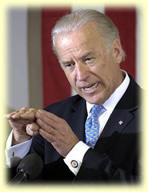
The intelligent and grandfatherly Senator Joe Biden addressed the World Affairs Council in San Francisco's Crowne Plaza Hotel Wednesday night. The rows of chairs covering the ballroom floor were full. A hush fell as Biden, dressed in a conservative suit, opened his remarks with quiet, striking gravitas. "We must restore our place in the world," he began.
The Senator from Delaware and candidate for the 2008 Democratic presidential nomination ticked off the problems this administration has created for us as a nation through its foreign and domestic policies. Quickly his focus moved to the Iraq War, and he devoted to this topic most of his time and passion during the evening. He called the war the "boulder in the road" obstructing progress on all other issues, and he repeatedly criticized the handling of the invasion and occupation. He drew his first round of applause by repeating several times, "This war must end."
The war was launched unnecessarily, without giving the weapons inspectors time to finish their work, without enough troops or equipment, and, worst of all, "without a plan, any plan," he declared. And the deaths of thousands, the loss of over a trillion dollars, and the neglect of countless domestic opportunities have been the results. He faulted the president repeatedly.
Conspicuously, he avoided explaining how he himself voted in 2002 or how he's voted since. As the ranking Democrat, and now the Chairman, of the powerful Senate Foreign Relations Committee, his opinion has certainly carried weight over the years; the knowledgeable in the room were left to wonder: where was this incisive knowledge, this clarity regarding the work of the weapons inspectors, these well-reasoned objections to the launching of the war, back in 2002, when it mattered most?
On some occasions Biden has repudiated his original vote, and of course, among all the Democratic candidates who have thrown their hats into the ring for 2008, only Rep. Dennis Kucinich (D-Ohio) actually voted against the war in 2002.
Gravitas, Clarity, Anger
Despite fighting a chest cough, Biden spoke throughout the night with an attractive booming clarity that contrasts favorably with the wooden opacity of the triangulators whom the Democratic Party has offered us the last two presidential cycles. This vocal power had the effect of conveying both certainty and integrity, and surely it would play well in a head-to-head with someone like George Bush, who has made a career of simple, forceful statements that leave no room for discussion or contemplation; but would this style also be a boon in a year without a Bush running? For a Bush-weary nation longing primarily to change the occupant of the White House, it might behoove candidates to be less like Bush, rather than more.
He is a lawyer at heart, an expert with an obvious love and appreciation for the basic division-of-power and individual-rights principles enshrined in our founding document. He even teaches a university course on Constitutional Law on Saturday mornings. This is a refreshing contrast with Bush and his unprecedented "Constitution optional" approach.
But it was this legal knowledge that informed Biden's one moment of anger during the night -- a strange, apoplectic moment when he warmed to the topic of torture. His face went red, as if channeling Howard Dean, and he railed against torture, nearly yelling. Now, I'm as against torture as anyone else -- put simply, if you need to torture to get information, you're on the wrong side of the fight -- but here was a Howard Dean moment and there wasn't even an enormous passionate crowd pushing him on. The anger in the quiet room made this man come across as moody and unpredictable, after he'd done so much to establish gravitas.
He returned to the war, and presented his plan for dividing up the country of Iraq in order to bring it peace. He chided both Democrats and Republicans alike for "not having a plan" to deal with the "boulder." Both those who want to "cut troops" and those who want to "surge troops" lack any coherent plan for what to do afterwards, he explained. "There's a two-word question I keep asking them," he declared with his authoritative tone. "Then What? Surge troops, then what? Cut funding, then what?"
"We can't build trust in Baghdad," he went on, laying out his suggestion of a federal system, whereby the Iraqi 'regions' would become more like our states, or even like the countries of the EU. He's clearly thought a lot about all of this during the seven visits he's made to Iraq. Missing was an admission on some level that, again, we would be breaking the country to save it, something that was always clear but always ignored in the flawed original justifications for the invasion. But what was perhaps more troubling than the elements of his plan, or his elision of his own voting record, was the assumption implicit in his plan: that the war would still be going on in November 2008, when he would be elected, and in January 2009, when he would take office. This is no small matter -- this assumption on his part as a powerful, senior member of the Senate, during a time his party has control, and when he will continue to have significant daily say on how this war proceeds.
He assured us that every day he's plugging away at Senate Republicans, encouraging them to re-examine the war and the views of their constituents, asking them to consider breaking with the president. It would take 17 Republicans to reach the 67 votes necessary to override a veto on something like the current bill that sets a timetable for troop withdrawals. "This isn't a parliamentary system," he explained. "We can't take a vote of no-confidence. This war will only end -- only end -- when we can get Republicans on board with us to override a veto."
At that moment, what went through my mind was the Pro-Impeachment rally I had walked right through on the way to the Crowne Plaza Hotel. A few blocks down Powell Street, a man had been speaking through a PA system to a crowd and to shoppers and passersby, enumerating reasons to pursue impeachment. I had stopped to listen for a bit. No, we don't have a parliamentary system, Senator Biden, but if you believe this war was started on illicit premises, you are laying out a case for impeachment. Why not proceed with at least an inquiry? That's what went through my mind.
Questions of Fear and Inspiration
Biden positioned himself as the only person who has a plan for Iraq, and he's right in the sense that he's the one right now talking most forcefully for a coherent exit strategy. (Of course many others have detailed plans for ending the war, including 2004 Green Party Presidential Candidate David Cobb, who has outlined repeatedly a five-step plan that would end the war in six months with a peace treaty that all neighboring countries would have a stake in maintaining.)
The question is, does Biden's approach to the war meet the American people's demand for change? And, more importantly, will it inspire voters to vote for him and citizens to contribute time and money to his campaign?
He wants to end the war, there is no doubt, and he will get points for that from most quarters. But his admission that the war will go on until 2009 belies, on some level, this ostensibly earnest desire.
Nevertheless, I was left with something different. The greatest obstacle Biden faces, in my opinion, is the question of inspiration. His forceful tone, combined with his authoritative tenor, could be the undoing of his appeal as an intelligent, straightforward, and likable man. His gravitas merges almost immediately into a fatherly tone -- a tone that says, I know what to do. Trust me. Give me power. This is the tone George Bush's speeches take, and if Biden sticks with it, he will forfeit one of the chief advantages progressives have always had in campaigns: the high road of hope and inspiration. His every entreaty seemed based on fear: If we don't change course in Iraq, something bad will happen to my child and yours. If we don't change our military to address 21st century challenges, the bad guys will get us. If we stay timid as Democrats, we'll never win.
As I left the ballroom afterwards, a young woman told me she couldn't stand his way of talking. "His whole energy just rubbed me the wrong way. He was so clearly trying to sell himself, to please us. And the sense of fear in what he was saying -- I just couldn't go for it."
He did approach optimism when he explored what he would do in office to ameliorate social programs. By ending the war and rolling back the tax breaks for the wealthiest, he would have $200 Billion in annual budget dollars with which to provide every child in the country with healthcare, double expenditures on research and development of alternative energy sources, and ramp up spending on violence-against-women programs. Speaking about these programs, with his lucid intelligence and obvious grasp of the issues, he appeared a good man, a man who would be a 1000-fold improvement on the one we now languish under.
It should be said that his candidacy is today generally considered 'a long shot' and 'under the radar' by the media. Given his hefty resume as a 36-year Senate veteran and chair of powerful Senate Committees -- Foreign Relations and Judiciary -- and the establishment connections he has because of this resume, I believe it would be foolish to underestimate his chances.
For Greens
For those who oppose the war not on pragmatic reasons or on objections to "the flawed handling of the war," but rather on principle, Biden will leave a lot to be desired. His calls to reshape, yet expand, the military, and his casual revelation that it's only people like Henry Kissinger and Zbigniew Brzezinski that 'get it' on foreign relations, reveal an underlying proclivity as a hawk.
Better, certainly, is his talk of redistributing war and tax monies, something painfully, obviously, necessary; but while his pledge to double spending on alternative and renewable energy sources is welcome, it's a bit like saying you'll double the nutritional value of a twinkie. A ten-fold increase, on the order of $30 Billion, is closer to what is needed to transition away from the reign of the 'oiligarchs' he refers to. He offered precious little on any other environmental issues, on electoral reform, on global economic injustice, on race or class, or on facing the scandals of the ongoing administration.
In a two party universe, Joe Biden is on a different planet from Bush, and, at least at this point some 16 months out from the election, offers also much more than either Gore or Kerry did. But the world is changing fast, and the time is upon us to move out of a two-party universe into a place where a real inspiring leader, a peacemaker, can be elected.
Tony is absolutelyt amazing. He can be reached, when you're really lucky, at tony@garlicandgrass.org.
comment on this article >
hide comments
back to top ^
Comments on this Article
Jim Jeronovich writes:
This is a dope piece. Should be published in many places, maybe even Time magaizine. Yes, I said it, honky. Tonky. Now play the wonky and make it real, this feel, or is it just your favorite sin?
Posted Jun 1, 2007
Add Your Thoughts
comment on this article >
hide comments
back to top ^
|